WARNING: Mainstream pet brands won’t reveal these hidden truths on their labels. Pay close attention to the the full breakdown by playing the video or clicking the button below before giving your dog another meal…
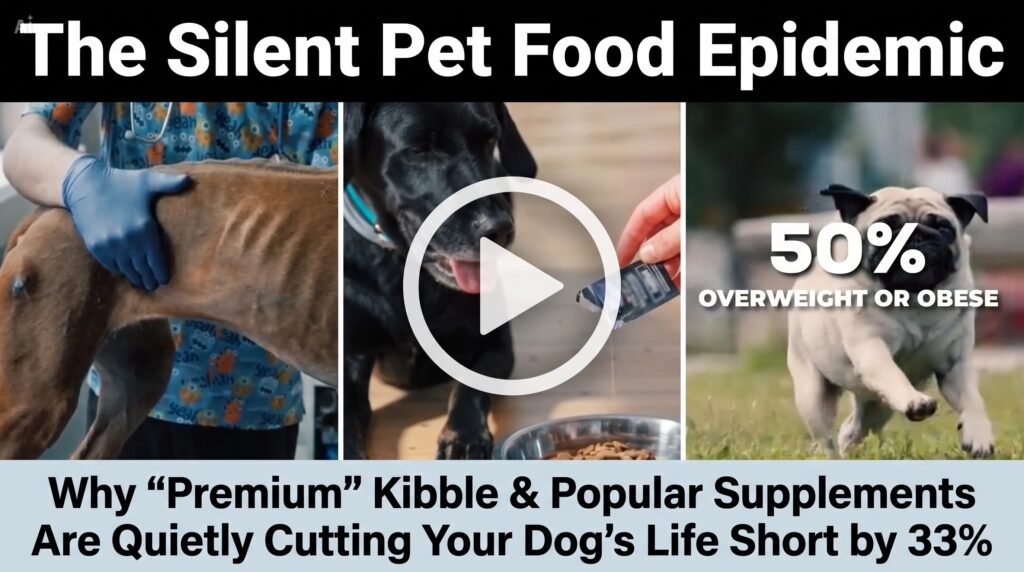
- The “3-Pound Myth” That Erases 33% of Your Dog’s Life: Discover why gaining a seemingly harmless 3 lbs on a dog is equal to a staggering 30 lbs on a human—and why standard “diet” pet foods actually accelerate this dangerous hidden weight gain.
- Why “Organic” & “High-End” Kibble Still Cause Internal Damage: The shocking 2020 study revealing how dry pet foods flood your dog’s body with harmful AGEs—triggering internal inflammation, joint decay, and cognitive decline no matter how “natural” the bag claims to be.
- The “Biological Bomb” Hidden in Modern Dog Supplements: Think adding a daily supplement helps? Learn why most pet supplements are laced with toxic food dyes and fillers designed to fool owners, while silently putting your dog’s health at risk.
- The 5-Second “Rib Test” Top Vets Use: How touching your dog’s back right now instantly reveals if they are part of the 56% of pets quietly suffering from unseen obesity—even if they look perfectly fine on the outside.
- The Natural Solution Big Pet Food Can’t Patent: Why feeding expensive “bio” foods isn’t enough for your pet to thrive, and the exact liquid nutrient breakthrough that counteracts processed food damage.
- Access the full breakdown by playing the video above, or clicking the button link immediately below.
Additional Resources & Background Research
The Silent Pet Food Epidemic: Why “Premium” Kibble & Popular Supplements Are Quietly Cutting Your Dog’s Life Short by 33%
Over the past century, the relationship between humans and domestic dogs has undergone a radical evolution. Canines transitioned from working farm companions fed raw meat scraps and bone broth to cherished family members sleeping on orthopedic beds. Yet, despite advancements in modern veterinary medicine, today’s pets are suffering from unprecedented rates of metabolic disorders, early-onset arthritis, cognitive decline, and chronic disease.
An emerging body of nutritional research points to a quiet culprit behind this decline: the industrialization of companion animal diets. Even high-end, “premium” dry kibble and heavily marketed synthetic supplements may be contributing to a systemic health crisis, silently shortening our dogs’ lifespans by up to a third.
1. The Historical Shift: From Ancestral Diets to Ultra-Processed Pellets
To understand how modern pet diets affect canine physiology, one must examine the evolutionary timeline. For over 15,000 years, wolves and early domesticated dogs survived on raw proteins, animal fats, organs, and small amounts of wild vegetation. Their digestive tracts evolved to process nutrient-dense, high-moisture foods with minimal carbohydrates.
The paradigm shifted rapidly during the Industrial Revolution. In the mid-1800s, commercial pet food was born with the invention of the hard “dog biscuit.” By the mid-20th century, the process of extrusion was introduced to mass-produce dry kibble. Extrusion involves mixing raw ingredients into a slurry, forcing them through a die under extreme heat and pressure, and baking the resulting pellets.
While extrusion made pet feeding convenient and cheap, it fundamental altered the molecular structure of the nutrients. High heat degrades delicate vitamins, denatures proteins, and strips natural moisture from food—creating a dry pellet that requires synthetic additives, flavor enhancers, and heavy carbohydrate binders (such as corn, wheat, or peas) to hold its shape.
2. Advanced Glycation End-Products (AGEs): The Biological Heat Trap
The primary mechanism driving metabolic stress in dry-fed dogs lies in a chemical process known as the Maillard reaction. When proteins and reducing sugars are subjected to intense thermal processing during manufacturing, they fuse together to form hazardous compounds called Advanced Glycation End-Products (AGEs).
When a dog ingests extruded kibble daily, these toxic compounds accumulate in bodily tissues faster than the kidneys and liver can filter them out. The physiological impact of AGE accumulation is severe and far-reaching:
- Arterial and Joint Stiffening: AGEs form cross-links with collagen, making blood vessels rigid and accelerating joint inflammation and cartilage breakdown.
- Cellular Oxidative Stress: They bind to specific cellular receptors (RAGE), triggering a cascade of systemic, low-grade chronic inflammation.
- Accelerated Aging: High circulating levels of AGEs are directly linked to metabolic dysfunction, canine cognitive dysfunction (similar to Alzheimer’s in humans), and organ strain.
Because dry food contains significantly higher concentrations of AGEs than fresh or raw diets, dogs fed exclusively on commercial kibble exist in a state of continuous internal oxidative stress, effectively accelerating the cellular aging process.
3. The Unseen Obesity Crisis & The 10% Life-Span Penalty
Alongside chemical toxicity, the high carbohydrate density of extruded foods has fueled an unprecedented canine obesity epidemic. Epidemiological data reveals that over 50% of domestic dogs are currently classified as overweight or obese.
Unlike human weight gain, which is easily noticeable, excess weight in dogs often accumulates subtly under dense fur coats. A gain of just three pounds on a small-to-medium dog is physiologically equivalent to a thirty-pound weight gain in an adult human.
The 10% Rule: Long-term veterinary longevity studies demonstrate that carrying just 10% to 15% extra body mass above ideal weight can reduce a dog’s average lifespan by up to 20% to 33%—erasing two to four vital years of life.
Excess visceral fat is not merely inert storage; it functions as an active endocrine tissue, constantly secreting inflammatory cytokines into the bloodstream. This chronic inflammatory state drastically increases the risk of osteoarthritis, insulin resistance, and cardiovascular strain.
4. Synthetic Supplements: A Double-Edged Sword
In response to growing health concerns, many pet parents turn to over-the-counter supplements. However, many mass-market pet supplements present their own biological hurdles.
To make chewables visually appealing to humans or palatable to pets, manufacturers frequently rely on artificial dyes, synthetic preservatives, and low-quality carrier oils. Synthetic vitamins lack the complex co-factors and enzymes found in whole-food sources, making them difficult for a dog’s liver and kidneys to process efficiently. Rather than neutralizing the damage caused by ultra-processed foods, poorly formulated synthetic additives can increase the organ load, compounding systemic inflammation.
Restoring Canine Vitality Through Whole-Food Principles
Mitigating the risks of ultra-processed diets requires a return to ancestral nutrition principles. While complete dietary overhauls can be complex, supporting canine longevity centers on reducing thermal-processed inputs and introducing fresh, nutrient-rich biological compounds. Integrating bioavailable antioxidants, healthy omega fatty acids, and moisture-rich whole ingredients helps neutralize oxidative stress, lower AGE burden, and support natural detoxification pathways—giving our companions the vibrant, long lives they deserve.